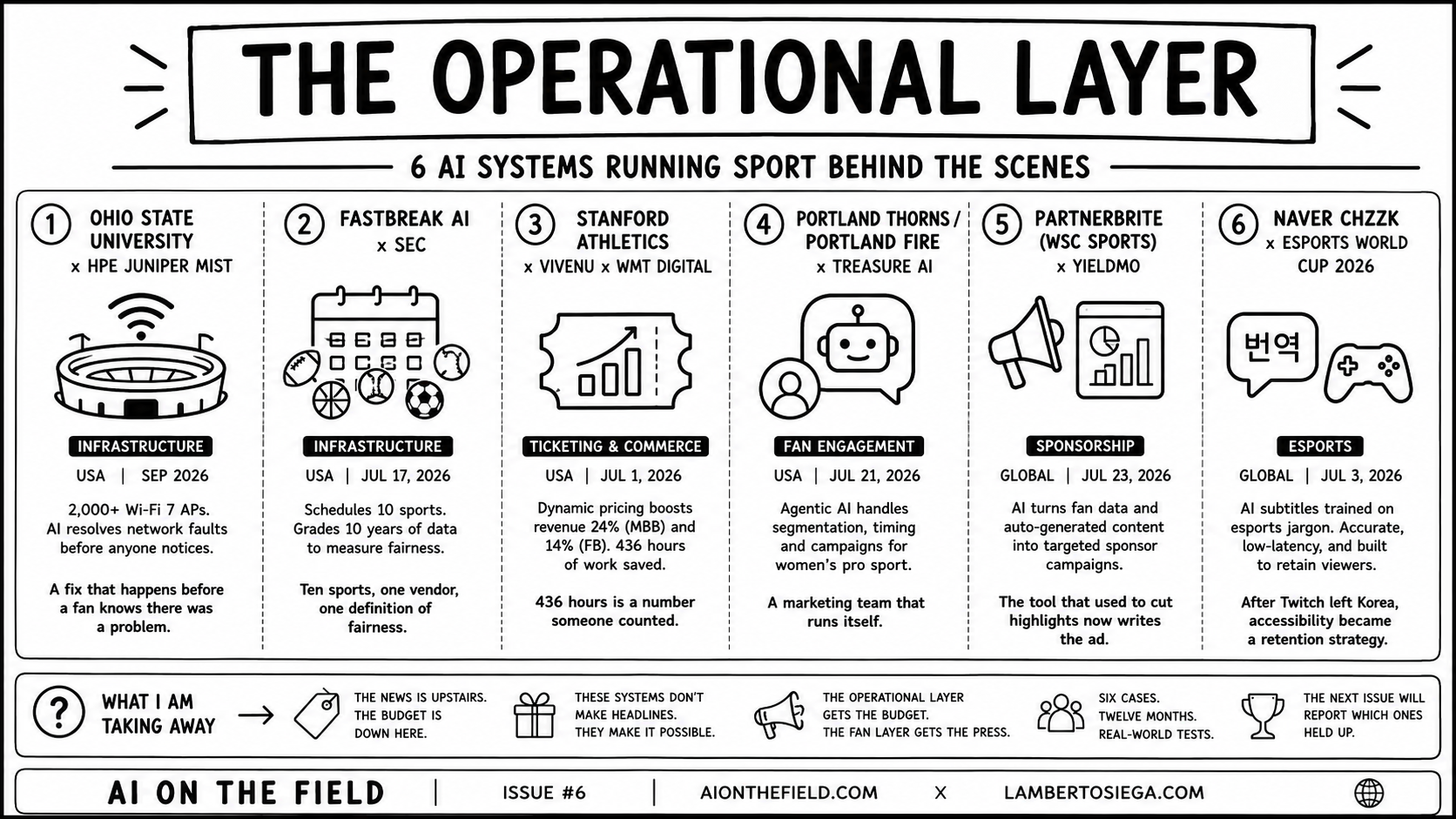
The operational layer.
Six cases this month. None of them talk to a fan directly. An access point in Ohio Stadium resolves its own network fault before an engineer notices. A scheduling system grades ten years of college sport calendars instead of one season. A pricing engine at Stanford recalculates ticket cost while a fan is still deciding whether to buy. A subtitle model in Seoul tracks esports jargon that changes weekly.
None of these systems produce a headline moment. Each one replaces a decision a human used to make, quietly, at a layer fans never see. Issue #5 covered AI narrating sport to an audience. This issue covers AI running the infrastructure underneath it.
1. Ohio State University x HPE Juniper Mist
Infrastructure | USA | Live from September 2026
Ohio Stadium is replacing a 2019 Wi-Fi 6 network with more than 2,000 Juniper Mist Wi-Fi 7 access points. HPE built the deployment around Marvis, an AI assistant that diagnoses and resolves faults such as stuck ports without an engineer touching a switch. A staff member can ask the system a question in plain language during a game. The answer arrives live, no ticket number required.
The scale matters on its own. This becomes the largest single HPE Juniper Mist deployment inside a US public venue. The operational claim is the sharper one. A fault that once triggered a support ticket, a technician walk, and a delay measured in minutes now resolves inside the network layer, before a fan notices a dropped connection.
A support ticket used to be the fastest path to a fix. Now it is the slowest one.
Atlético de Madrid x HPE (Issue #1) managed bandwidth inside a football stadium. Ohio State runs the same vendor's AI across an entire university network, stadium included. The debut in September will be the first real test at full crowd load. Nobody has published failure data yet, because nobody has run it at scale yet.
2. Fastbreak AI x SEC
Infrastructure | USA | Announced July 17, 2026
Fastbreak AI extends its agreement with the Southeastern Conference to cover scheduling across ten sports: football, men's and women's basketball, baseball, softball, soccer, volleyball, tennis, gymnastics. The Fastbreak Pro Schedule platform balances venue availability, travel distance, competitive equity, and broadcast windows across every one of them at once.
The new element is measurement. Scheduling already existed. Fastbreak now scores calendar quality against multiple years of historical data instead of judging one season in isolation. A conference can finally ask whether this year's travel burden on a given program is an anomaly or a pattern.
Ten sports, one vendor, one definition of fairness.
USA Taekwondo x Fastbreak AI (Issue #0) put the same company inside a single Olympic sport. Here it sits inside the scheduling logic of the wealthiest conference in college athletics. Longitudinal scoring is a genuine improvement over season-by-season guesswork. It also means one company now holds the historical baseline against which every future SEC schedule gets judged.
3. Stanford Athletics x Vivenu x WMT Digital
Ticketing & Commerce | USA | Reported July 1, 2026
Stanford Athletics dropped fixed ticket tiers for dynamic pricing built by Vivenu and WMT Digital, covering basketball and football. In one season: a 24 percent average revenue lift per ticket in basketball, 14 percent in football, and 436 hours of manual pricing work removed from the ticketing staff's calendar.
Those numbers separate this case from most partnership announcements in the archive. A press release claiming efficiency is common. A season of verified revenue delta against a fixed baseline is rare.
Four hundred thirty-six hours is not an estimate. It is a number someone counted.
SeatGeek in ChatGPT (Issue #1) moved ticket discovery outside official platforms. Stanford moves pricing inside a model that recalculates continuously rather than in weekly batches. The gain is real. The market is also a college athletics department, where fans are less price-sensitive than season-ticket holders at a professional franchise, and the numbers may not travel cleanly to that context.
4. Portland Thorns / Portland Fire x Treasure AI
Fan Engagement | USA | Announced July 21, 2026
RAJ Sports named Treasure AI the Official Agentic Experience Platform for the Portland Thorns and Portland Fire, its NWSL and WNBA franchises. Autonomous agents built on MCP architecture handle fan segmentation, message timing, and campaign activation, replacing a conventional customer data platform with something closer to a marketing team that runs itself.
The partnership is the first AI-native deal built exclusively for US women's professional sport. Marketing systems built for two women's franchises from the first line of code. Nothing here started as a men's league system with the logos swapped.
A marketing team that runs itself, built for a league that has never had one before.
Mercury13 x Catapult (Issue #1) made the same argument about performance data. Models built directly from female athlete data outperform ones adjusted from male-sport defaults. Treasure AI applies that logic to marketing systems instead of biometric data. The word agentic is doing a lot of work here. RAJ Sports has not published a single retention or revenue figure to back it yet.
5. Partnerbrite (WSC Sports) x Yieldmo
Sponsorship | Global | Announced July 23, 2026
Partnerbrite, owned by WSC Sports, combined Yieldmo's contextual ad system with WSC Sports' automated content engine to launch Fan Media Networks: sponsor campaigns built and targeted on first-party fan data, running cookieless across premium sports sites.
The distinction from a standard retail media network is where the creative comes from. WSC Sports already generates highlight packages automatically, a capability this magazine covered in LALIGA x WSC Sports (Issue #3). Partnerbrite turns that same generative pipeline toward advertising creative. Match content was only the first application.
The tool that used to cut a highlight reel now writes the ad that runs next to it.
Fieldhouse Media Network (Issue #1) proved fan data could become a cookieless ad channel on its own. Partnerbrite closes the loop from data to finished campaign inside a single vendor stack. Genius Sports, Stats Perform, and WSC Sports now each control a growing share of the pipeline that runs from raw fan data to the ad a fan actually sees.
6. Naver CHZZK x Esports World Cup 2026
Esports | Global | Announced July 3, 2026
Naver extended its rights agreement with the Esports Foundation to three years, securing exclusive Korean-language coverage of all 25 Esports World Cup 2026 events. English broadcasts now carry AI-generated subtitles trained specifically on esports terminology, tuned to stay accurate at the latency live competitive play demands, alongside automatic clip generation and match chaptering.
Generic subtitling models choke on esports vocabulary. A term like objective or teamfight means something precise inside a match and something else outside one. Training on that vocabulary is a narrow, defensible technical claim, nothing more.
After Twitch left the Korean market, an accessibility feature became a retention strategy.
Eurovision Sport x CAMB.AI (Issue #1) applied the same real-time subtitling problem to the Paralympic Games. Naver's version solves it for a domain-specific vocabulary and ties it directly to a service with a competitive reason to keep viewers from leaving. The subtitle is a feature. The lock-in is the business model.
What connects these six cases
Issue #5 covered systems that talk to fans. These six systems do not talk to anyone. They fix a network fault, price a ticket, build a calendar, target an ad, subtitle a match, and route a marketing message, all without a person approving the individual decision.
None of them make headlines the way a generative video tool does. The operational layer of sport is where AI adoption compounds fastest. Nobody outside operations staff is watching closely enough to slow it down.
The fan-facing layer gets the press coverage. The operational layer gets the budget.
Ohio State's network will carry a full stadium crowd for the first time in September. Stanford's pricing model will run through an entire football season for the first time this fall. Fastbreak's longitudinal scoring will produce its first multi-year verdict on SEC scheduling equity next spring. Each of these six cases has a specific date in the next twelve months when it either holds up under real load or does not.
The next issue will report which ones did.