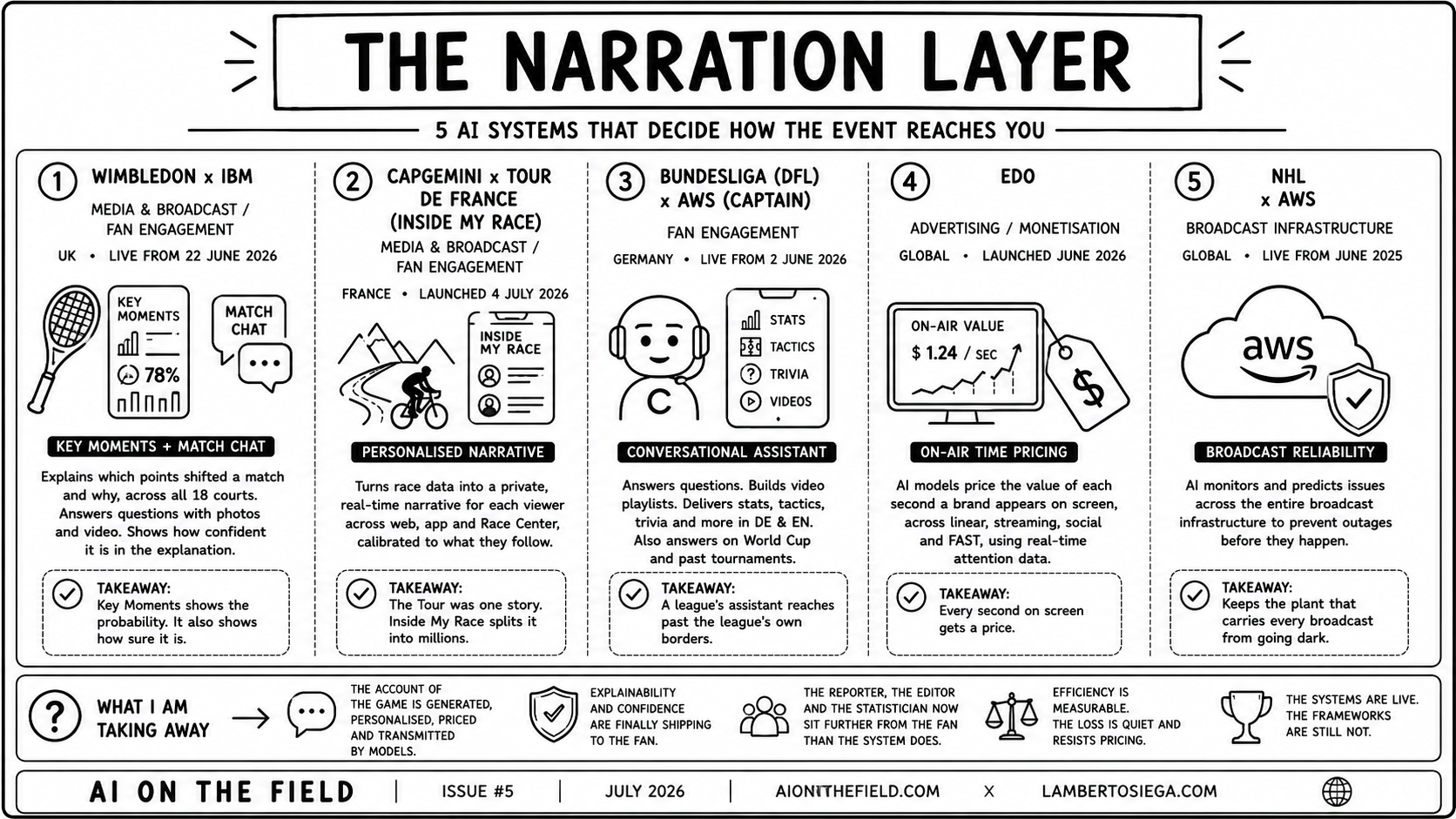
The narration layer.
Five deployments this month. Four of them do the same job. They decide how the event reaches the person watching it.
Wimbledon explains which points turned a match and states how confident it is in the explanation. The Tour de France writes each viewer a private version of a 3,400 km race. The Bundesliga answers a fan's question by assembling a video playlist on request. Beneath them, EDO prices what a brand's second on screen is worth, and the NHL keeps the plant that carries every broadcast from going dark. The account of the game is generated, personalised, priced and transmitted by models. The reporter, the editor and the statistician now sit further from the fan than the system does.
The account of the game is generated, personalised, priced and transmitted by models.
Issue #3 ended on a sentence: the systems are live, the frameworks are not. Issue #5 is where the first framework arrives. Wimbledon shipped explainability and confidence scoring as a product feature, across one tournament and 18 courts. It stops short of a governance standard, and no independent party has verified it. It is still the first live sports AI in this archive to show its own uncertainty to the people it addresses.
1. Wimbledon x IBM
Media & Broadcast / Fan Engagement | UK | Live from 22 June 2026
IBM rebuilt Wimbledon's entire digital platform on watsonx for the 2026 Championships. Two features face the fan. Key Moments sits on top of the existing Likelihood to Win model and explains which points shifted a match and why, across every singles match on all 18 courts. Match Chat, built on watsonx Orchestrate, answers questions in plain language through agents trained on Wimbledon's editorial voice and the vocabulary of tennis, returning photos and video inside the answer.
The rebuild ran on IBM Bob, a development accelerator. It mapped 15,000 archive assets into a knowledge graph and extracted them in 47 minutes. Work that normally occupies four or five specialists for months finished in four weeks. Computer Weekly described the result as ten years of development compressed into nine.
Key Moments shows the probability. It also shows how sure it is.
IBM attached explainability, confidence scoring and human-led review to the live features. A model that reports its own certainty gives the fan something the older systems withheld. Issue #3 documented deployments that overrode umpires and answered 500 million cricket fans with no accountability chain in any public document. Wimbledon ships the accountability layer in the same release as the feature.
One question stays open. AELTC has not committed to publishing figures that isolate the effect of Key Moments and Match Chat, and no outside party audits the confidence scores. Explainability announced by the vendor is a claim. Explainability measured by someone else is evidence. The distance between the two is where the next argument will happen.
2. Capgemini x Tour de France (Inside My Race)
Media & Broadcast / Fan Engagement | France | Launched 4 July 2026
Capgemini took over as the Tour de France's technology partner from NTT, with an agreement running to 2029 across 14 cycling events. On 4 July it launched Inside My Race, a generative AI capability that turns race data into contextual narrative and personalised rider insight in near real time. Each viewer assembles a private account of the stage across the web, the app and the Race Center, calibrated to what they follow.
Capgemini built and deployed the feature inside the first year of the partnership. The replacement speed carries its own signal. A technology partner once meant fixed infrastructure that a property kept for a decade. NTT held the Tour for nine years. Capgemini swapped the entire stack and shipped a live generative product in one.
The Tour de France was a single narrative followed together. Inside My Race splits it into millions.
Cycling suits personalisation. A stage runs for hours across 3,400 km, and no broadcast shows every rider to every fan at once. A model that builds each viewer their own thread solves a real problem of attention. It also dissolves something. The Tour has always been one story watched by everyone at the same time. When the account fragments into millions of versions, the collective fact of the event thins out. The efficiency is measurable. The loss stays quiet and resists pricing.
3. Bundesliga (DFL) x AWS (Captain)
Fan Engagement | Germany | Live from 2 June 2026
The DFL added a conversational assistant called Captain to the official Bundesliga app, built with AWS. It reaches live statistics, historical match data, tactical breakdowns, trivia and video, in German and English. A fan can ask for every headed goal Harry Kane has scored and receive a personalised video playlist in return. Captain recommends content from a fan's in-app behaviour and preferred clubs, and it runs a daily quiz that adapts to the user's level with country leaderboards. Through the summer break it also answers on 2026 World Cup and past-tournament data.
A league's assistant reaches past the league's own borders.
DFL and AWS appeared in Issue #0 as a broadcast automation case. Captain shows where that partnership travelled. The work moved from automating production to a companion that generates content on demand for each fan. The Bundesliga reached production with generative AI while other leagues were still testing, and this deployment holds that lead.
The World Cup access changes the position. A league assistant that answers questions about football beyond its own competition becomes the interface a fan uses for the whole sport. That is a lock-in. Once the companion becomes the habit, the fan stops looking anywhere else, and the league that owns the companion owns attention that used to move freely across the game.
4. EDO x FIFA World Cup (Sponsored Ad Outcomes)
Sponsorship | USA | Launched 10 June 2026
EDO launched Sponsored Ad Outcomes for the 2026 World Cup, a vertical AI system that detects, classifies and quantifies brand exposure inside a live broadcast. It reads in-stadium signage, digital scorebug overlays, Sponsored By graphics and studio segments, then attaches its own TV outcomes data to each one. The system ran across all 104 matches in real time. EDO back-tested it on the 2022 World Cup, 64 matches and 24 brands, and reported that digital overlays drive 117% higher engagement likelihood than in-stadium boards.
Unmeasured, sponsorship was priced by negotiation. Measured, it becomes a market.
FIFA and Stats Perform in Issue #1 showed data as monetisation infrastructure on the supply side. EDO prices the demand side. Sponsorship has been the most opaque asset a rights holder sells, valued by reputation and reach, never by outcome. A system that converts a second on screen into a quantified figure turns that opacity into a spreadsheet.
Whoever produces the number sets the valuation. The measurement standard becomes the inventory valuation for every club and league that accepts it. A rights holder that adopts a third-party metric as its reference hands the pricing of its own asset to a vendor. The open question is whether the industry converges on one standard, or whether each measurer publishes its own and rights holders end up negotiating over figures that do not compare.
5. Presidio x NHL
Infrastructure | USA | Announced 25 June 2026
Presidio renewed a multi-year technology partnership with the NHL that sits beneath the broadcast. It never faces the fan. The core is the Virtual Technology Operations Center, a cloud control system that pulls dozens of production workflows and venue feeds into one interface and supports more than 1,300 games a season. The NHL Draft Application runs on hybrid cloud and centralises Operations, Clubs, Communications, Central Scouting and Central Registry, handling pick submissions, announcements and trades live at the Buffalo Draft. The NHL Watch Comms App, built with Apple, sends haptic alerts to on-ice officials for period countdowns, penalty expiry and clock time. It reaches 95% of on-ice officials.
At 95% adoption, a failure here interrupts the game itself.
Every other case in this issue points the model at the fan. The NHL points it at the plant. The VTOC treats the venue as one system, the quiet counterpart to the loud fan-facing features elsewhere. It concentrates risk. One integrator now runs broadcast, draft and officiating communication at once.
The Watch Comms App has become critical infrastructure at 95% adoption. Atletico and HPE in Issue #1 raised the question at stadium scale. Here it returns at league scale. When the stack becomes the condition for the event to happen at all, control of the stack is control of the event, and the vendor holding it holds more than a contract.
The story becomes the system
Issue #2 traced the move from testing to production. Issue #3 documented systems that decided faster than any human could review them. This issue lands on the layer where those decisions meet the fan, and on the first sign of a control built above it.
Four of the five deployments generate, personalise or price the account of the event. Wimbledon explains the match. The Tour writes each fan a private race. The Bundesliga answers on demand. EDO prices the exposure. The narration of sport, work that belonged to broadcasters and journalists, moves into models that run in real time at a scale no editorial desk can match.
The frameworks were absent. At Wimbledon, one arrived. It shipped as a product. No one made it a standard.
The governance step deserves attention and resists celebration. Wimbledon attached explainability and confidence scoring to a live system, a first in this archive. It arrived as a feature on one tournament, controlled by the vendor, checked by no one outside it. A framework that exists because a product manager chose to include it leaves the same way.
The next twelve months test two things. Whether explainability spreads from Wimbledon to the other narration systems, or stays a single showcase. And whether one sponsorship measurement standard wins, or the market splinters into figures that do not compare. The systems that tell the story now decide what the story is. Watch who writes their rules, and whether anyone outside the vendors checks the work.