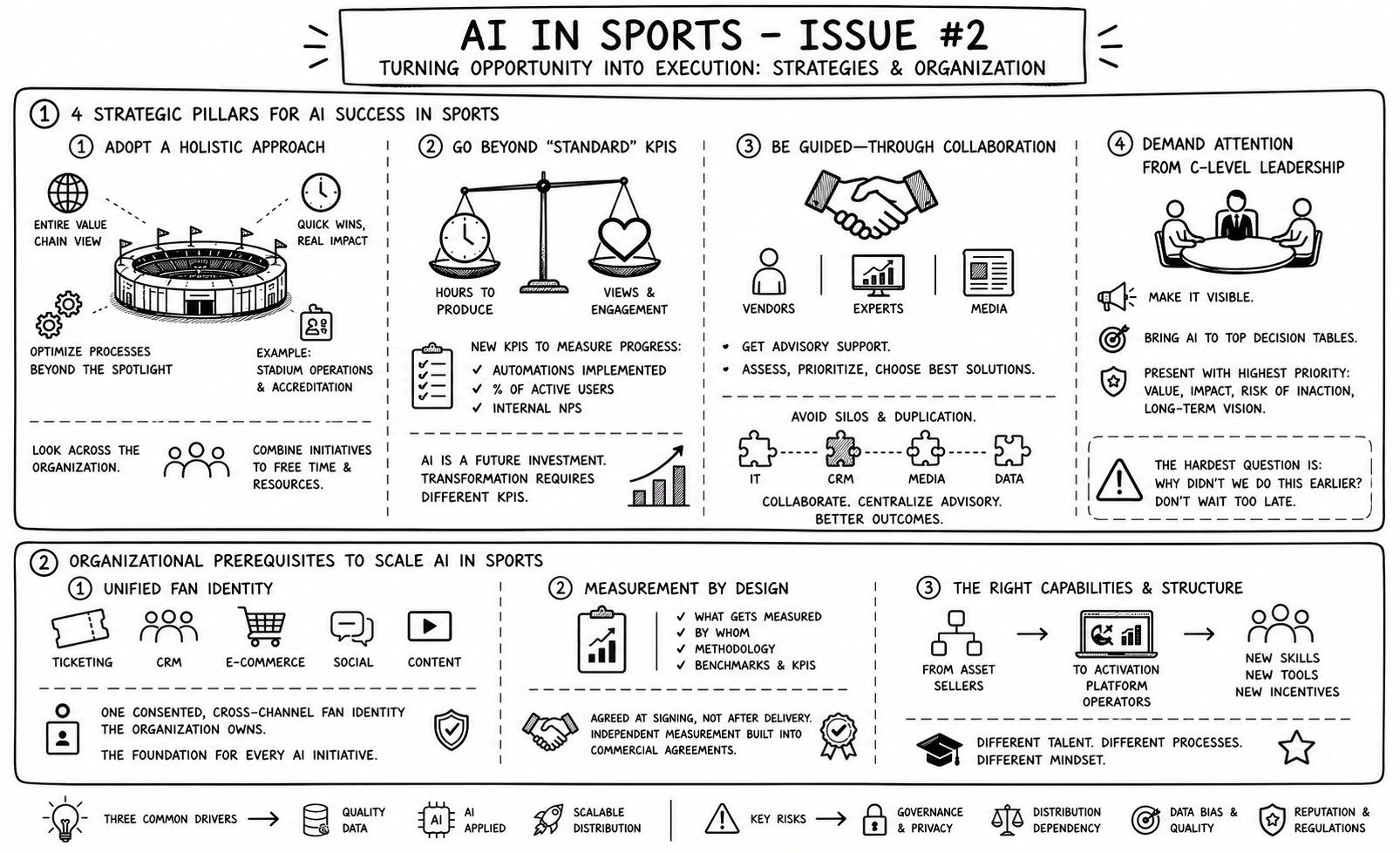
AI enters production. Not as a promise — as infrastructure.
Five cases this month. Five signals pointing in the same direction: AI in sport has stopped being a research and development topic. It has become an operational layer — inside race operations, inside the app where you buy your running shoes, inside the VAR system judging an offside call at the World Cup.
This is not hype, not communications, it is infrastructure. And the difference is not semantic.
1. DICK'S Sporting Goods x Adobe — Sporting retail goes agentic
The most significant case this month does not come from a league or a club. It comes from a sporting goods chain.
DICK'S Sporting Goods has announced a partnership with Adobe to deploy conversational AI agents — Adobe Brand Concierge — as a "digital coach" inside its mobile app. The stack is concrete: Adobe Experience Platform to unify customer data, Real-Time CDP for real-time segmentation, Journey Optimizer for cross-channel orchestration. The result is a system that intercepts the user's intent — not past behaviour, present intention — and responds with personalised recommendations based on sport, goal and level.
Why does this matter in a sports context? Because DICK'S is not just a retailer. It is often the first touchpoint millions of amateur athletes have with the organised sport ecosystem. Bringing an AI layer into that moment means intercepting a relationship before it forms elsewhere — and turning that to commercial advantage.
The risk is symmetrical to the value: when advisory becomes algorithmic, you lose the productive friction of the expert sales associate who convinces you to buy differently from what you planned. Total personalisation optimises conversion, but not necessarily the right choice for the athlete.
2. Williams F1 x Anthropic — Inside the paddock, AI is already at work
The news is not that Williams signed with Anthropic. The news is the context: according to Ampere Analysis data cited by Reuters, eight new AI deals have been signed across Formula 1 in the last six months. McLaren with Gemini. Red Bull with agentic Oracle shaping pit wall decisions. Aston Martin with CoreWeave for the CFD pipeline. Ferrari on Amazon SageMaker running simulations 60% faster.
The F1 paddock in 2026 is probably the densest and most documented enterprise AI deployment in world sport. Not because teams are more innovative than other sports organisations, but because the new technical regulations changed the mathematics of car development: with restrictions on physical wind tunnel testing, whoever can simulate more in the digital environment gains a structural advantage that compounds over a season.
Williams has named Claude its "Official Thinking Partner" — a formula that apparently says everything and nothing at once. What differentiates it from ordinary partnerships is that Anthropic engineers work embedded within the Williams strategy team. They are not providing a tool: they are working inside the decision-making process.
How far does the model's autonomy extend in race decisions? Who leads whom?
The boundary between analytical support and operational recommendation is the real frontier, and no press release has addressed it.
3. MLS Innovation Lab 2026 — The "test in production" model
In its third year, the MLS Innovation Lab has refined an approach that deserves attention regardless of the individual cases selected.
The principle differs from an accelerator or a traditional partnership programme: the five selected startups do not test in simulated environments, but at real events — MLS All-Star Game, MLS NEXT Fest, Generation Adidas Cup. At the risk of a public failure, MLS gets immediate feedback and market validation in return.
Among this year's selected projects: Advanced Image Robotics for automated video capture and WMT AI Ticketing for AI-driven dynamic pricing. Two areas — media production and ticketing — where technological maturity is already high but adoption in second-tier leagues remains partial.
The Lab model works as technology scouting for the league and as a commercial launchpad for startups. The systemic risk is fragmentation: each cohort brings different stacks that struggle to converge into a single operational platform. But perhaps that is not the point.
4. Manchester City x YBVR — The question VR in sport has not yet answered
City Space is a technically well-built product. 180° content from both men's and women's matches, first-person perspectives, behind-the-scenes access, continuous updates throughout the season. The partnership with YBVR on the Xtadium platform for Meta Quest is one of the most organic VR implementations seen in football.
The issue is not the quality of the product. It is audience behaviour.
VR in sport has a friction problem that no partnership has yet solved: putting on a headset requires an active intention that passive consumption of highlights on Instagram does not. City Space can be extraordinary as an experience and marginal in scale. Or it can become the reference point for a format that gains traction once content quality reaches a critical threshold.
It would be worth monitoring actual usage numbers — which will obviously not be communicated.
5. FIFA x Lenovo — Democratising analysis, but at what cost?
Football AI Pro is the most interesting element of the package announced by FIFA and Lenovo for World Cup 2026 — not because it is technically the most sophisticated (the 3D avatars for the offside VAR system are probably more complex) but because it carries a structural implication.
The tool will be available to all 48 teams. The explicit idea is to level the playing field: national teams with fewer analytical resources will have access to the same tactical intelligence layer as the game's most established sides.
It is an honestly credible statement of intent, but it raises a question the press release does not address: if all teams use the same system built on the same model trained on the same data, the competitive advantage shifts to the quality of the human interpretation of that output — not to access to the data itself.
In other words: Football AI Pro could democratise access to analysis and simultaneously increase the value of the professionals who can use it well. That is not necessarily a problem. But it is precisely the opposite of what the democratisation narrative suggests.
The thread connecting the five cases
Looking at these five cases together, a pattern emerges that goes beyond individual announcements.
AI in sport in 2026 manifests in three distinct forms: as a tool embedded in mission-critical decision-making processes (F1, FIFA World Cup), as a personalisation layer in the relationship with the consumer (DICK'S, City Space), and as an institutional mechanism for technology scouting and co-development (MLS Lab) — confirming what emerged in Issue #01.
None of these projects is a pilot anymore. They are operational deployments.