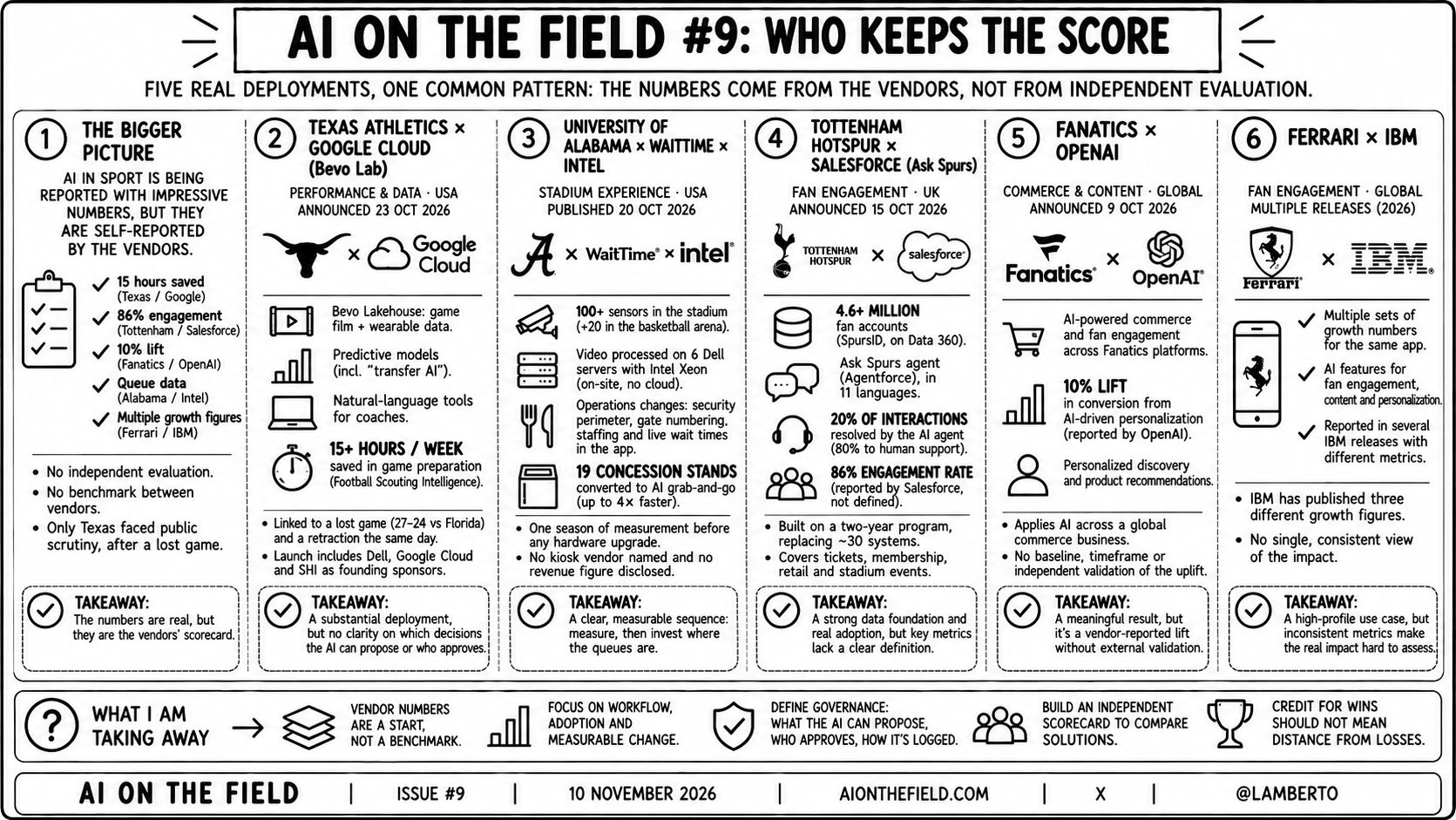
Every figure in this issue was published by the company that sold the system. Google reports the 15 hours saved at Texas. Salesforce reports the 86% engagement at Tottenham. OpenAI reports the 10% lift at Fanatics. Intel publishes Alabama's queue data, and IBM has released three different sets of growth numbers for the same Ferrari app.
That is how sports AI gets disclosed in late 2026, and it limits how far any of these numbers can travel. A rights holder cannot benchmark a vendor with the vendor's own scorecard. The only moment this month when a system faced public scrutiny came at Texas, after a lost game, and the athletic department responded by stepping back from its own tool.
Five cases passed the filter between 6 October and 10 November: a named stack, a primary source, a deployment live or scheduled on a stated date. Esports, athlete health, data rights and sponsorship produced nothing that met it.
1. Texas Athletics x Google Cloud (Bevo Lab)
Performance & data · USA · Announced 23 October 2026
Texas lost 27-24 to Florida on 17 October after a failed fourth-and-2 in the fourth quarter. On 23 October, the day Bevo Lab launched, the Austin American-Statesman reported that the staff had turned to the platform for that call. Within hours athletic director Chris Del Conte clarified that he had cited the play only as an example of what the platform could suggest. The launch and the retraction shared a news cycle.
The launch itself is substantial. Texas Athletics and the Business of Sports Institute at the McCombs School of Business built Bevo Lab with three founding sponsors: Dell for infrastructure, Google Cloud as cloud and enterprise AI provider with Gemini, SHI as integrator (Google Cloud announcement: www.googlecloudpresscorner.com/2026-10-23-Texas-Athletics-and-the-McCombs-School-of-Business-Launch-New-Bevo-Lab,-Bringing-Together-Sports,-AI,-and-Analytics). Bevo Lakehouse merges game film and wearable data into one warehouse, starting with football and planned across 21 varsity teams and more than 500 athletes. On top sit predictive models, including a "transfer AI" for roster evaluation, and natural-language tools for coaches. Google says workflows built with its Public Sector engineers already save coaches more than 15 hours a week in game preparation. Press coverage names the tool behind that figure: Football Scouting Intelligence, which compiles opponent data and video that staff used to assemble by hand.
Fifteen hours is a workflow number. It describes a report that gets written faster. It says nothing about whether the report improves decisions, and no evaluation outside Google's release has been published.
The fourth-down episode carries the larger signal. Sevilla x IBM (Issue #0) and Buffalo Sabres x SprintAI (Issue #8) put AI into sporting decisions without saying who answers for its advice. Texas is the first case in this archive where a sporting outcome was tied to a system in public, and the first where the institution withdrew the claim the same day. Learfield's Longhorn Sports Properties secured the founding sponsors, so the lab is also a commercial asset carrying partner brands. Those incentives favour credit for wins and distance from losses.
Texas has not published which decisions Bevo Lab may propose, who approves them, or how a recommendation is logged. Until it does, every future close game will reopen the same question, and the answer will again depend on the scoreline.
2. University of Alabama x WaitTime x Intel
Stadium experience · USA · Published 20 October 2026
Long lines at the gates used to top Alabama's postgame surveys. They no longer make the top ten. That is the result of a system running at Bryant-Denny Stadium since summer 2025 (Intel: www.intel.com/content/www/us/en/newsroom/news/artificial-intelligence/intel-edge-ai-turns-football-crowd-data-into-revenue.html): WaitTime software reads overhead Axis sensors at entrances and concession stands and tells apart people progressing in a queue from people passing or gathering nearby. More than 100 sensors cover the stadium and 20 more the basketball arena. Video is processed on six Dell servers with Intel Xeon processors inside the venue and never goes to the cloud.
The operations team acted on what it saw. It moved the security perimeter away from the ticket scan, changed gate numbering and staffing, and pushed live wait times into the athletics app with red, yellow and green markers. For 2026 the data justified converting 19 concession stands into AI grab-and-go kiosks, which Alabama says process transactions up to four times faster.
New Ryan Field x Mashgin (Issue #8) went cashierless on opening day, with no prior baseline to compare against. Alabama spent a season measuring before it touched a single counter. Any venue budgeting an upgrade can copy the sequence: one season of measurement, then spending where the queues are.
The gaps are commercial. The release names no kiosk vendor and puts no figure on the revenue gain the CTO describes. The survey result belongs to the university, and it reaches the public through a chip maker's newsroom.
3. Tottenham Hotspur x Salesforce (Ask Spurs)
Fan engagement · UK · Announced 15 October 2026
Four conversations in five with Ask Spurs still end with a human. Salesforce reports that 20% of interactions are resolved by the Agentforce agent alone, and frames the result around a different number, an 86% engagement rate it does not define (Salesforce: www.salesforce.com/news/press-releases/2026/10/15/tottenham-hotspur-becomes-agentic-enterprise-with-agentforce/).
The groundwork is the more durable asset. Over two years Tottenham replaced around 30 systems and connected more than ten into one ecosystem. Salesforce Data 360, linked to Snowflake through Zero Copy, now holds more than 4.6 million fan accounts as SpursID profiles. Ask Spurs sits on that record, answers in eleven languages on the club site and app, and covers tickets, memberships, retail and stadium events for members and guests. When it cannot resolve a question, it passes the conversation to the support team.
Ask Spurs is older than the release. CTO Rob Pickering presented it in April 2026. October supplies the first metrics. Tottenham featured in Issue #8 for the HPE network that runs its stadium; it returns here for the agent that answers its fans. Both deployments describe the same strategy at different layers of the club.
The figure to track is the 20%. A self-service share that climbs season on season would show the agent absorbing support volume. A flat one would mean the club built a front door that sends most visitors to the same desk as before.
4. Fanatics x OpenAI (Shop the Look)
Ticketing & commerce · USA · Announced 26 October 2026
The official online stores of the NFL, NBA, MLB and NHL now carry outfit recommendations generated with OpenAI (OpenAI: openai.com/index/fanatics-streamline-fan-experience/). Fanatics rebuilt Shop the Look, the module that suggests matching items on a product page, so that a fan looking at a jersey sees an in-stock cap, socks and accessories from the same team and style. OpenAI helped design it and Fanatics engineers built it with Codex, working against a catalogue CNBC puts at more than 1.5 million SKUs. In testing on roughly 30,000 MLB products, OpenAI reports engagement 10% above the previous version.
SeatGeek in ChatGPT (Issue #1) moved a ticket purchase into OpenAI's interface. This case runs the other way. OpenAI's technology enters the retailer's own store, on pages the leagues license, and the fan never leaves the merchant. For a league, that keeps the customer relationship where the licensing contract already sits.
Three data points are missing. The release measures engagement with suggestions and publishes no conversion, basket size or revenue effect. Codex is named as the build tool, while the model that serves recommendations in production goes unnamed. The test covered one league's catalogue, and the rollout covers four.
5. IBM x Scuderia Ferrari HP (Race Summaries)
Fan engagement · Italy · Announced 22 October 2026
Scuderia Ferrari HP now publishes an AI-written recap of every session, minutes after it ends. For the United States Grand Prix, IBM extended Race Summaries from race day to practice, sprint and qualifying (IBM: www.prnewswire.co.uk/news-releases/ibm-and-scuderia-ferrari-hp-expand-ai-powered-fan-experience-ahead-of-the-united-states-grand-prix-302916287.html): agents built on watsonx turn timing data and statements from the drivers and team principal into narrative. The same update added Race Timeline, a Pitstop Reaction Game and a Tifosi Hub for fan stories. IBM says it built the features with IBM Bob and IBM Consulting Advantage, using more than 70 reusable AI skills and over 30 agents, and measured a 30% productivity gain in app development during the Monza and Madrid weekends.
The adoption numbers do not line up. In May, IBM reported 62% more views and 35% more engaged sessions one year after the app relaunch. Its case study claims daily active users doubled. The October release cites 35% more downloads and 36% more monthly active users over the first year. Three releases, three metric sets, one app. None comes with a baseline a reader could check.
Wimbledon x IBM (Issue #5) used watsonx to explain which points decided a match. At Ferrari the same stack writes the team's official account of its own sessions, in the team's voice. That moves the model from analysis to authorship. IBM does not say how much human review a recap gets before it reaches the app.
This is the sixth IBM case in the archive. A partner with that much presence in sport could publish one consistent time series for one app. Until it does, the Ferrari figures cannot be compared with each other, or with anyone else's.
Five vendors, one scorecard
Five deployments, five sets of numbers, and each number has the same source: the vendor. Alabama's survey result is the only figure that starts inside the rights holder, and it still reaches readers through Intel's newsroom.
No single vendor will close this gap, because each one gains from publishing its own metric in its own way. The leverage sits with buyers. A club or league can write two clauses into the contract: the right to publish its own results against a stated baseline, and a named owner for every decision the system can propose.
By the end of the 2026-27 season, at least one major league or Power Four athletic department will publish an AI decision policy that names what its systems may recommend and who signs off. After 23 October, Texas has the strongest reason to go first.