Analysis | Global | September 2026
The compliance clock has already rung twice this year
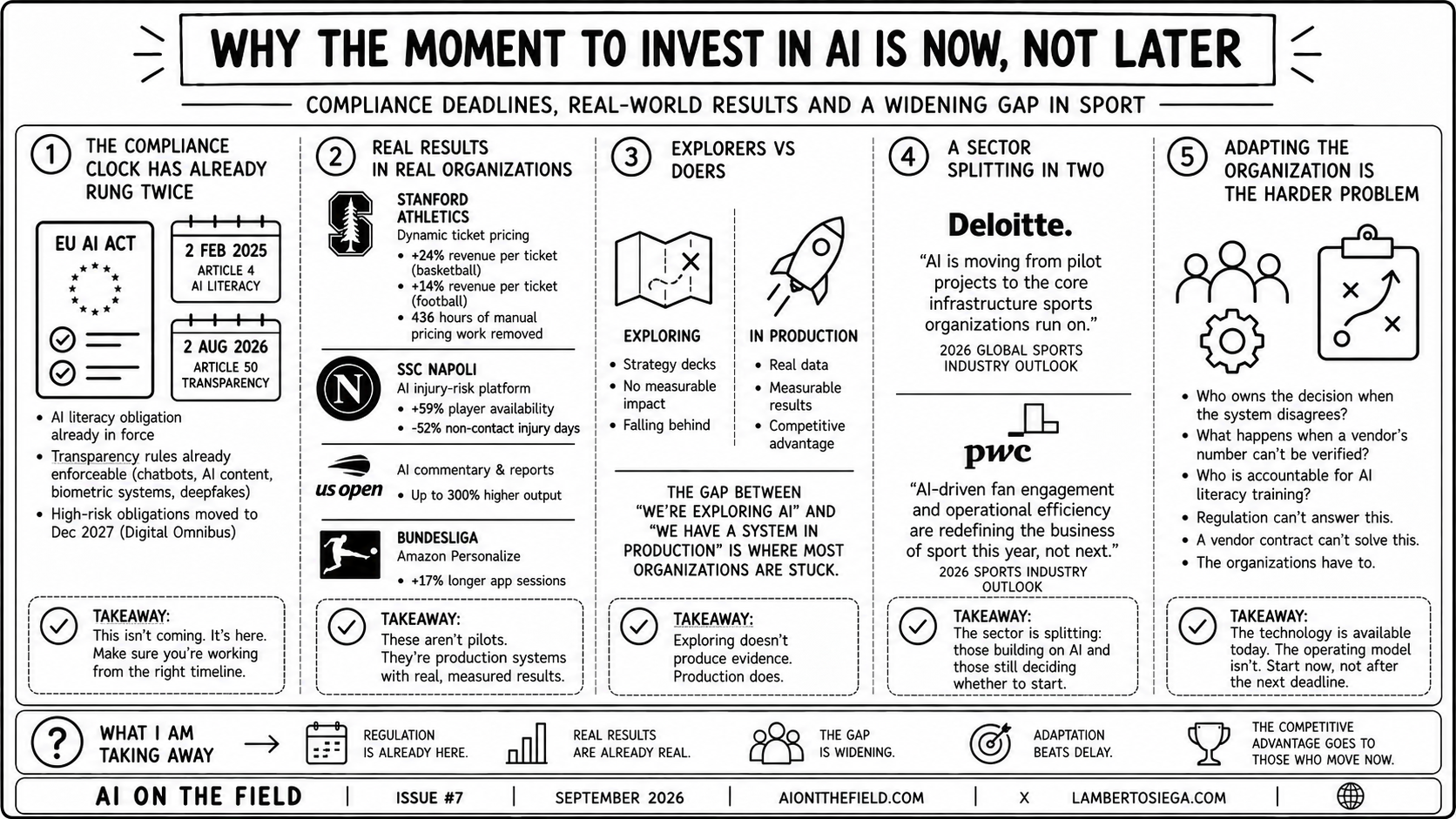
Two EU AI Act deadlines have already passed. Article 4 requires organizations to ensure staff working with AI systems have adequate literacy. It became applicable on 2 February 2025, over a year and a half ago. Article 50 covers AI chatbots and virtual assistants, AI-generated content, emotion recognition and biometric categorization, and deepfakes. It became enforceable on 2 August 2026, five weeks before this was published. A club running an AI commentary system, a fan-facing chatbot, or biometric access control at a stadium is likely already inside Article 50's scope.
The deadline that didn't arrive is the one most compliance calendars were built around. The heavier obligations covering hiring, credit scoring, and biometric categorization under Annex III were pushed from August 2026 to December 2027. A late amendment, the Digital Omnibus on AI, made the change on 8 July 2026. A large share of "AI Act 2026" guidance written before that date already describes rules that no longer apply.
Whoever is advising you may be working from a timeline that already expired. Check which version they're using.
What "AI in sport" actually means today
Market-size projections for 2025 range from under $2 billion to over $10 billion depending on which report you read. That range says more about methodology than about the market. Set the projections aside. What's measurable is what specific organizations have shipped, and what happened after they did.
Stanford Athletics moved ticket pricing for basketball and football to a dynamic model built with Vivenu and WMT Digital. Average revenue per ticket rose 24% in basketball and 14% in football in a single season, while cutting 436 hours of manual pricing work. SSC Napoli's medical staff adopted an AI injury-risk platform from Zone7 and recorded a 59% increase in player availability and a 52% drop in non-contact injury days the same season. The club's own data doesn't isolate the platform's specific contribution from squad quality or medical staffing.
The US Open's editorial team says its watsonx-powered commentary and match-report tools lifted output by up to 300%. IBM reports that figure; nobody has independently audited it. The system generates content served directly to the public, which is exactly what Article 50 now requires labeling as AI-generated. Bundesliga's app sessions run 17% longer since Amazon Personalize went live.
These are production systems, in their second or third season. The numbers are measured, sometimes contested, sometimes vendor-reported. That distinction separates an actual deployment from a press release.
WHY IT MATTERS
The gap between "we're exploring AI" and "we have a system in production with a season of data behind it" is where most organizations are stuck. Production generates evidence that exploration cannot, for better or worse.
Leaders and everyone else
Deloitte's 2026 Global Sports Industry Outlook frames it plainly: AI is moving from pilot projects to the core infrastructure sports organizations run on. That shift is already splitting the sector into two groups. Some are building on it. Others are still deciding whether to start. PwC's parallel outlook for 2026 puts AI-driven fan engagement and operational efficiency among the themes redefining the business of sport this year, not next.
What's missing is the tier below the biggest clubs and leagues. A recent sector scan found no independent instrument to measure AI-readiness at the federation level. There's no standard way for a national federation, a mid-size league, or a regional body to know where it stands relative to peers, or what to fix first. The organizations already running production systems have a season of evidence. Everyone else has a strategy deck and a compliance deadline that started a year and a half ago.
Adapting the organization is the harder problem
Every technology in the cases above can be purchased. The operating model that makes it work has to be built in-house: who owns the decision when the system disagrees with the coach, what happens when a vendor's claimed number can't be verified, who is accountable for the AI literacy training that's already legally required. Vendors supplied the technology. Organizations built the governance around it — Napoli's medical protocols, Bundesliga's product roadmap, the US Open's editorial standards.
That's the part regulation can't wait for and a vendor contract can't solve. It's also the part every organization still has time to get right, if it starts before the next deadline forces the question.